E-bike with belt drive
Just like with regular bicycles, there are a range of different drives available to choose from in an e-bike. Many pedelecs have a chain drive, but some models are available with a belt drive. For city riders as well as for riders who spend a great deal of time on their bicycles or enjoy travelling very long distances, a belt drive offers a number of advantages worth considering. Learn more here!
What is a belt drive on an e-bike?
Both belt drives and chain drives for e-bikes work on a similar principle. However, in a belt drive, the chain is replaced by a looped belt that has teeth on the inside of the loop. The toothed belt runs over a belt pulley that is attached to the crank, and then over another, smaller belt pulley attached to the rear hub. This, by the way, is no ordinary belt, but a belt made from extremely strong carbon fibres, so it can go a very long time before wearing out.
Who should consider an e-bike with belt drive?
Broadly speaking, any e-biker could consider an e-bike with belt drive. People who are particularly maintenance-averse will find the belt drive ideal: a carbon-fibre belt wears significantly more slowly than an ordinary chain. And it also requires no oil, so you do not need to worry about oil stains on the clothes you cycle in. This may be a particular advantage for people who take their e-bike to work.
What gear systems are compatible with a belt drive on an e-bike?
A belt drive on an e-bike can only be combined with hub or bottom bracket gears. One of the best-known hub gear systems is the Rohloff, which was specially designed as an alternative to derailleur gears.
What are the advantages of a belt drive?
A belt drive offers several advantages. One of them, as already mentioned, is the low maintenance. But there are other reasons to consider a belt-driven e-bike:
The belt is very long-wearing, so has a much longer lifetime than a chain drive.
A belt drive requires no maintenance.
A belt drive requires no oil or grease, so both the bicycle and your clothes stay clean and grease-free.
The belt drive weighs less than a chain drive, so your e-bike is lighter overall, which in turn saves energy and ultimately helps your battery life.
An e-bike with belt drive is amazingly quiet compared to a chain drive.
The belt drive is not affected by wind or weather conditions.
There are, however, also a few minor disadvantages:
The belt drive cannot be used in combination with derailleur gears.
A belt drive is slightly less efficient than a chain drive. This is not due to the belt itself, but rather to the fact that hub gears are generally somewhat less efficient than derailleur gears; however, this difference is not something an everyday cyclist will particularly notice.
Which e-bikes have a belt drive?
These days, there are really no e-bike segments where one cannot choose a belt drive. E-trekking bikes, e-mountain bikes, city bikes and even foldable e-bikes with belt drives are already available.
Our E-bikes with belt drive
What is better for an e-bike: a chain or belt drive?
A comparison of chain drives and belt drives reveals that each has its own advantages and, naturally, its fans. The following tips may help you decide which of the two drives to choose:
1. As you travel
If you only ever cycle in Germany, availability of both belts and chains will not be a problem should you have a breakdown. This may be different in other countries. A replacement chain should be available virtually anywhere, but if cycling abroad with a belt drive, you would be advised to carry a replacement belt with you.
2. Frames
A belt drive requires a special frame. The reason for this is that most drive belts cannot be separated for mounting like a chain can. This means that mounting the belt requires the frame to be opened using a special frame lock. There are a few separable belts available now, but these are a relatively new development.
3. Costs
A drive belt costs more than a chain. However, because the drive belt lasts longer and requires less care and maintenance, its higher purchase cost pays off in the long run.
4. Power transmission
At high RPMs of the electric motor, a belt drive has a higher power transmission efficiency than a chain drive. This is not the case during casual riding at normal speeds, in which case a chain drive will generally be more efficient.
5. Tearing of chains vs belts
Some would have you believe that a drive belt is prone to breaking, but this is simply not the case. A sudden breakage of the belt on an e-bike virtually never happens. The same can be said for a chain, although, for a chain to retain its performance qualities, it requires regular maintenance. In either case, trouble-free functioning of the drive is contingent on correct assembly, tensioning and fitting of the chain or belt.
6. Bad weather
Since the belt is made of carbon and not metal, in situations involving bad weather, the belt definitely outperforms the chain. It shrugs off water and moisture and can never rust. Without frequent cleaning and oiling, chains will suffer from contact with water.
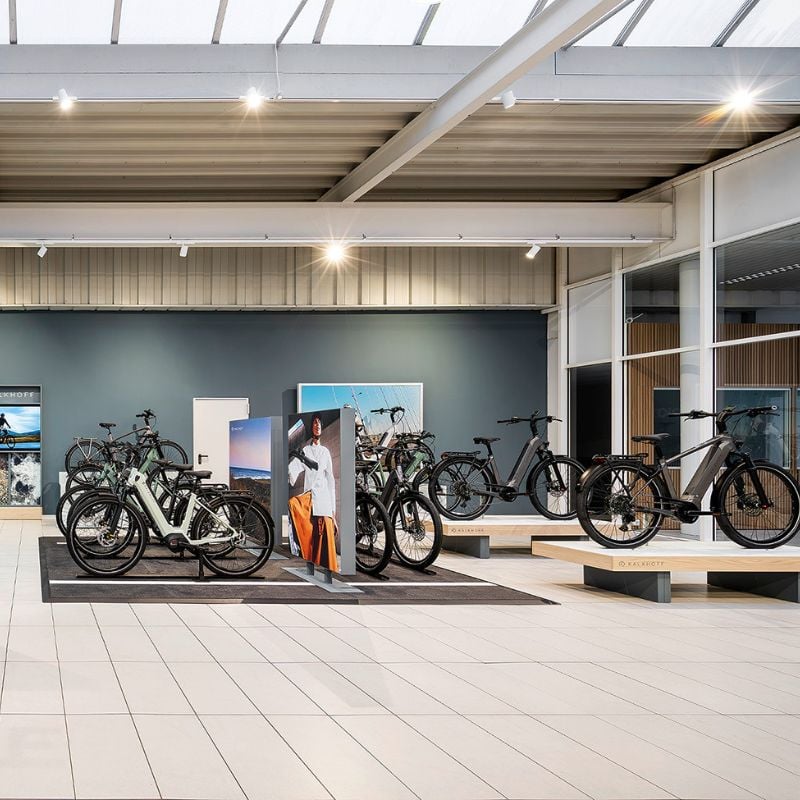
Are you looking for a new Kalkhoff e-bike and would like to see the different models in person or try them out for free first? No problem!
ADVICE
Everything you need to know about e-bikes. From technology and purchasing to daily use.
DEALER SEARCH
You can easily find a specialist dealer near you using our dealer search.
KALKHOFF WARRANTY
Register your Kalkhoff e-bike and enjoy a 10-year warranty on all e-bike frames.